Bogged down by the effects of
recession on critical sectors of the country’s economy, Nigerians turn
to booze for succour, writes GBENGA ADENIJI
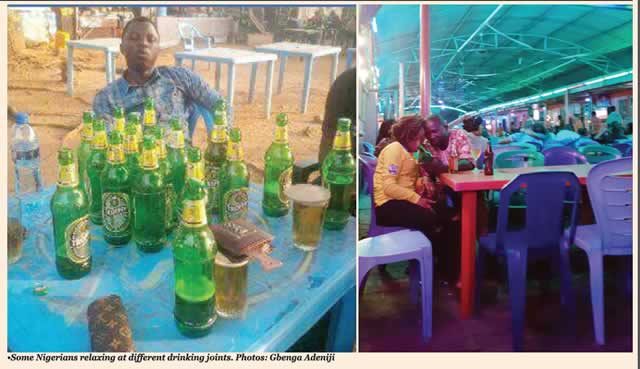
The music was deafening. A crowd of
alcohol drinkers in cheery discussions populated the beer parlour joint.
It was carnival-like with smoked fish, grilled meat and other spiced
edibles competing for space across tables.
From the urbane to the unsophisticated, the excitement enveloping the rendezvous cast an unmistaken jollity on their faces.
For a second, you might be tempted to ask: what recession?
Amid the frenzy, 28-year-old Akeem Oladimeji sat on a deserted table, alone, fondling his smartphone.
The beer lover and photographer had
taken four bottles for the night. He was on the verge of emptying the
content of the fifth one when our correspondent nestled to him.
Staring dispassionately into his
half-filled glass, he stated that despite the economic recession,
nothing had changed in the booze world.
Nigeria, Africa’s largest economy, is in
recession for the first time in 25 years, largely due to a fall in
global oil price and mismanagement of the economy by past governments.
The Business Dictionary defines
recession as a considerable decline in Gross Domestic Product for two or
more consecutive quarters.
The situation continues to take its toll
on critical sectors of the country’s economy, resulting in job losses
in the banking, aviation and manufacturing sectors among others.
It is also significantly visible in real income, wholesale retail trade, employment and industrial production.
Many states and private companies also owe workers backlog of salaries while others are getting half salaries.
However, Nigerians are not consuming
less alcohol. Oladimeji is one of many Nigerians who have found comfort
in a bottle of beer. He said that in fact, he recently fell in love with
a new beer brand.
He said, ‘‘I take five bottles daily and
drink three times a week. Nothing has changed in the booze world. As it
was in the beginning of booze, so it is now in time of recession and so
it shall continue to be. Booze does not understand the language of
recession.’’
Alcohol love in recession
A phone engineer, Ganiyu Olajide, told our correspondent that he drinks to erase his worries.
“I may be thinking about something or
bothered but once I start drinking, I take it off my mind. I may return
to the worry the next day but for that moment, I forget all worries,’’
he said gulping a glass of beer.
Noting that the recession was biting hard and affecting his business, Olajide said drinking takes all his worries away.
Olajide said, ‘‘I take four bottles
weekly. It used to be three bottles. Once I finishing drinking in a day,
I go to sleep and forget all my worries for the night. The next day,
things will sort themselves out.”
He stated that before the recession, a lot of artisans usually patronised him to repair their mobile phones.
“The situation is so bad now that my
customers prefer to use the money they make to cater first for their
needs. Some may even be proposing repair on credit and will I survive
with such? A man who has not eaten cannot be thinking of repairing a
damaged or problematic phone, ’’ he added.
Economic figures from Nigeria paint a
dire picture. The Central Bank of Nigeria in a recent report noted that
the country’s external reserves fell by 2.86 per cent to $25.45bn on
August 29, 2016 while the National Bureau of Statistics stated that the
nation’s inflation rose to 17.1 per cent from 16.5 per cent. The bureau
also stated that the unemployment rate had increased to 13.3 per cent
from 12.1 per cent.
Similarly, the NBS noted that investment
inflow into the country experienced a vast drop of $4.51bn from $8.08bn
in the first nine months of 2015 to $3.57bn in the same period of 2016.
This situation has forced many parents
whose children were attending private schools to withdraw them to less
fee-paying schools. Some cannot even afford to pay school fees at all
and hence, leave their children at home.
The predicament was well captured by the
National President, National Association of Proprietors of Private
Schools, Dr. Sally Adukwu-Bolujoko, who noted that economic recession
had forced many parents to withdraw their kids from private schools.
Kunle Olusola who was seated beside
Olajide, kept lamenting that the recession had made it difficult for him
to pay his children’s school fees.
Notwithstanding this development,
Olusola’s drinking pattern has not been affected in anyway. He said
drinking at the beer parlour helped him bond with other drinkers while
they discuss their problems.
Olusola has a unique way of drinking: he
adds malt drinks to his beer. He said this combination enabled him
drink for a longer period.
He said, ‘‘Recession has affected
everything but we have to drink beer. Booze kills brooding. One cannot
be drinking and be brooding at the same time. No matter the issue on my
mind, once I finish drinking, I retire to bed.’’
Speaking with SUNDAY PUNCH, one
of the regular drinkers at a bar in Ogun State, Dotun, said he noticed
an upsurge in drinking since recession began. According to him, more
people now go to beer parlours to drown their economic sorrows in
alcohol.
Dotun added, “Whenever I want to drink, I
can take five bottles of my favourite beer. My drinking has not
stopped, if anything, I take a bottle extra. If any regular drinker in
Nigeria says he is affected by recession, then it means before
recession, that person has not been drinking well. People drink even
more now. You need to see bars, clubs and joints on weekends.”
Opposite Dotun was a seller of second-hand clothes, Akachukwu Eze.
Eze noted as he sipped the dreg of the
beer bottle he held, ‘‘I cannot kill myself. I have to move on because
if one does not move on with life, life will surely move one. I try to
bury my pains and thinking by drinking. I take two bottles twice weekly;
Saturdays and Sundays. The level of lack and poverty has increased with
recession. Notwithstanding, people have to drink.
“People do not buy new clothes not to
talk of buying second-hand clothes now as recession bites harder. They
prefer to use the money they have to buy what to eat than buy clothes. I
am thinking of a new business idea to complement the business I do at
the moment.
“Rather than indulging in things that
one could regret later, I prefer to forget whatever is bothering me at
that moment by drinking. Though I know that drinking gives part-time joy
away from sorrows, the momentary joy would go a long way in stabilising
one, especially at this time.”
Besides, a former worker with a
Lagos-based construction company, identified as Emeka, who is a regular
customer in one of the bars located at Social Club Road, Abule Egba,
said many Nigerians would have become depressed but for booze.
He told our correspondent that his
troubles escalated when he lost his job in October this year, adding
that things had since become tough for him.
According to him, he decided to indulge in drinking because over time, it has proven a reliable activity anytime he is unhappy.
Emeka, who said he drinks three cold
bottles of his favourite beer brand every day, stated that such often
cleared his mind of worries.
He told SUNDAY PUNCH while
waiting for the server who took his orders, “As the first child of my
aged mother, it has become my responsibility to cater for her and my two
siblings after the death of our father in 2014. I was working with a
construction firm before I got laid off with some other workers as the
company downsized. The management said it was due to recession. Since
then, I have been searching for a new job.
“I met some of my friends and told them
to inform me of any vacancy in their work places. It was in November
that I realised that I should find another thing to do because that
month marked the third month after I was sacked. Where are the jobs when
companies keep sacking their workers to survive? I know that the fall
of a man is not the end of his life. I have faith that things will get
better someday. I am planning to start a small business once I get some
money because the recession is really affecting the poor. Drinking helps
me cope with the harsh economic condition in the country. Nigeria is a
tough place to live in.”
The bald man who is in late thirties,
stated that he could have become frustrated but for booze which created
an avenue for him to meet others with varied problems.
Despite having drunk enough beer for the
day, the drinkers gladly accepted the one bottle each which our
correspondent ordered for them.
Beer parlour owners reap big
Indeed, beer parlour owners couldn’t be
happier. For over 35 minutes, Stephen, who runs a beer joint in Lagos,
attended to his retinue of customers as our correspondent waited for
him.
Decked in light blue Polo shirt and grey
shorts, Stephen beamed with smiles as he moved across tables to take
orders in tow with his three servers.
“Please pardon my delay. As you can see,
customers are many. It is Sunday and peak time for our business,’’ he
said pleading for permission to attend to another group of customers who
interrupted the interview.
It took him another 11 minutes to take their orders. Stephen told SUNDAY PUNCH that business had increased despite the recession.
Stephen said, ‘‘People still drink every
day recession or no recession. I now have more customers on specific
days like the weekends. My customers are even experimenting new beer
brands that cost same price as their favourite.”
Similarly, the owner of Ogun State-based
relaxation centre, Fun Gate, Mr. Femi Gate, said that people complain
about the situation in the country but are drinking more.
“Some drink five to six bottles daily.
Some customers also come around four times weekly. Each customer takes
an average of 24 bottles in a week. Recession has not affected beer
parlour business. Even though the price of each of the brands (beer,
stout, malt) has gone up by 20 per cent, people still drink,’’ Gate
said, clearing the empty bottles on a table occupied by three men and a
lady.
He also said patronage increases during days of English Premiership matches which are usually Saturdays and Sundays.
Great added, “I do not charge a fee for
viewing of the matches but anybody who comes in to watch must buy a
drink. It is part of my strategies to drive sales.”
He disclosed that he used to sell about
13 crates of beer weekly before recession started, adding that it had
increased to about 25 crates.
“On some weekends, I sell more than 25
crates depending on a number of factors like if customers want to get
together. I envisage more sales during the festive period despite the
recession, ’’ he added.
Mrs. Azeezat Oseni, also called Iya
Basirat, is another beer seller who currently reaps from the nation’s
recession. She told our correspondent that she added to her brands of
alcohol when her customers started demanding more.
‘‘Some people when coming from work
prefer to stop by and drink. They always tell me that they want to use
alcohol to erase their worries. Some take like three bottles and pay at
once at the rate of N250 each while others pay for one or two and
promise to complete the rest. One thing I do not allow is for my
customers to drink entirely on credit.
“It is interesting that even as bad as
the economy is, Nigerians still find money to drink. It is good for my
kind of business any way because I make good sales every day and mostly
on weekends,’’ said the beefy woman, whose shop is at Surulere, Lagos
State.
Also, a beer distributor and owner of
Lagos-based Emakudeb Investments Limited, Mr. Ebong Ema, said people are
drinking more in recession.
“There is a particular brand of beer I
sell which enjoys huge patronage now. People still drink. As a beer
distributor, I should know if people drink more or less,” he stated.
Another beer distributor and owner of
Cash World, Mrs. Folashade Olonade, who distributes products of the two
major brewery firms in Nigeria, noted that the price increase on the
beer brands had not discouraged people from drinking.
She said, ‘‘I think Nigerians are
drinking more now for some reasons. The economic situation in the
country is responsible for it. There are some people who believe that
drinking will take their minds away from whatever is bothering them.
They only need to drink a bottle of beer and they forget all their
worries. Also, some Nigerians enjoy drinking and whether there is
recession or not, they drink. Even if a bottle of beer costs N1,000,
they won’t hesitate to buy it.
“Another reason is that there are some
Nigerians who enjoy hanging out with friends. They enjoy catching fun.
This category of people prefer to be with friends to drink. One fact is
that Nigerians are drinking more in recession. The demand of retailers
and what I supply to them attest to this.’’
Breweries smiling to the bank
The leading brewery company in Nigeria,
Nigerian Breweries Plc, posted a profit after tax of N38.06bn last year,
as against N42.52bn in 2014.
The company, in its audited financial
statements for the year, ended December 31, 2015 submitted to the
Nigerian Stock Exchange, noted that its revenue rose to N293.91bn from
N266bn at the end of 2014.
The company, also in its half-year
financial statements submitted to the Nigerian Stock Exchange, recorded
1.85 per cent gain with Guinness Nigeria Plc reporting 1.07 per cent
gain.
Similarly, Guinness Nigeria Plc
announced a revenue increase of six per cent for its first quarter
financial year which ended September 30, 2016.
The Media Relations Manager, NB Plc, Mr.
Chukwuemeka Aniukwu, and the Corporate Relations Director of Guinness
Nig. Plc, Mr. Sesan Sobowale, did not respond to enquiries by our
correspondent to comment on the development.
While Aniukwu via a text message pleaded
for some time to respond, Sobowale, in an auto email response, noted
that he was on holiday and would treat the request next year.
Nigerians are however not restricted to
only beer consumption. A global market research firm, Euromonitor
International, in a report titled, ‘Champagne: Nigerian chic and
European doldrums’, stated that Nigeria was the 23rd largest champagne
importer in the world.
The report indicated that in 2014, the
country imported 768,131 bottles while the top three countries on the
list; UK, US and Germany imported 34 million bottles, 19 million bottles
and Germany 13 million bottles respectively. It noted that Nigeria
remained the top importer of champagne in Africa.
Drinking and sorrows as companions
A professor of psychology at the Obafemi
Awolowo University, Toba Elegbeleye, said there was a correlation
between drinking and sorrow.
He said, “When people are frustrated
either by meeting a brick wall in business, lack of money or job losses,
they tend to seek pleasure to bury the problem in. Drinking is one of
the options in that situation. For instance, a man who is jilted by his
girlfriend may want to bury that sad experience in booze.
“People take the drinking option because
it creates a pleasurable avenue for gist and gossip which make the
troubled person get temporary relief.”
He added that any noticeable increase in
drinking by Nigerians during recession could be linked to the need to
find pleasure away from the current economic woes.
Also, a lecturer at the Department of
Psychology, Faculty of The Social Sciences, University of Ibadan, Oyo
State, Dr. Grace Adejuwon, linked sadness to alcohol intake.
The lecturer further said many people
drink more during recession to release the stress of not having money,
unhappiness and inability to meet societal expectations because of the
worsening financial distress.
“Many people believe that drinking will
make them happy and take their minds away from the hardship in the
country notwithstanding the momentary joy drinking may give,” she noted.
Commenting on the effects of alcohol on
the body, a health management consultant, Dr. Adebiyi Gbadebo, said
moderate intake of alcohol could excite the heart and brain.
Gbadebo added that the drinker would
easily mask his worries with alcohol during consumption leading to the
making of wrong judgments due to the inability to think properly.
He noted, ‘‘He or she will make wrong
decisions depending on what they are doing at the time of drinking. For
example, if a man is driving, he may move at a dangerous speed and the
consequences may be disastrous. After the remission, the scenario he or
she is trying to mask will return.”
Gbadebo, who is also the Publicity
Secretary of the Association of General and Private Medical
Practitioners of Nigeria, added that long-term intake of alcohol could
cause brain damage, intense mental health, liver and heart problems.
Last week, President Muhammadu Buhari
gave the assurance that the recession will come to an end in 2017. This
was good news for Nigerians but until this happens, the green bottle
will remain a companion of many.


0 comments:
Make sure you comment below, share your thought, feel free to ask us anything, we will reply immediately
Thank you for being part of gistlife